Archive for 2020

Home / 2020

The pandemic has affected us all in some way or another. It’s changed the way we live, work and interact with the world – as well as with brands.

Six months in and a number of macro trends have emerged, writes Econsultancy. Shopper behaviour has transformed alongside the climate, brand purpose has never been so vital, and genuine communications are resonating most with consumers.

As we edge towards more economic uncertainty and an increase in unemployment, it’s key FMCG marketers take into account people’s changing habits. With this in mind, here are five tips to help you navigate the fast-paced, evolving landscape:

  • Deliver value at both ends of the funnel 

Quality online experiences are key to brand value, but it’s just as important to deliver value at the till. Providing creative initiatives that deliver value across formats – like HFSS guideline-compliant bundle deals and subscriptions – will help bigger brands retain customer loyalty and fight off the private label resurgence.

  • Operate with sustainability in mind 

Sustainability can no longer be an afterthought – especially when considering that 60% of under-30s’ purchase decisions are purpose-driven. The pandemic has only spurred the shift to more sustainable brand behaviour – big FMCG companies have the power and potential to implement positive change and lead the societal shifts required now and in the future.

  • Creativity beats time and place 

Simply putting ads out online isn’t enough to capture consumers’ attention. Utilising new platforms and formats can help brands provide an extra layer to the effectiveness of their creative, increasing ‘thumb-stopping moments’ by adding moments of unexpectedness. 

Embracing creative effectiveness will likely increase sales. An example being Lush, which paired up with Deliveroo UAE to design a ‘self-timing’ soap that dissolves within 20-30 seconds of thorough use. It’s an ingenious solution that removes the guesswork out of hand hygiene and is extremely memorable.

  • Think mobile-first 

Online and social media have become even more vital and are proving a substitute for what used to be outdoor leisure activities. As the move online continues to adapt, implementing a mobile-first strategy will help you capture new audiences in virtual shopping moments. 

If consumers choose mobile shopping as their leisure activity of choice, then FMCG brands will have to think of innovative ways to stay relevant and distinguishable from other brands.

  • Do the right thing AND say the right thing 

With the majority of people still at home, FMCG brands can play a part in helping consumers forget their woes while at the same time, lift their spirits. This enables them to enter their audience’s lives in a meaningful way, rather than being focussed solely on profits. 

Take Maltesers, which produced a series of short ads called ‘Isolation Life’. It featured women on a video call in funny and relatable situations, providing some humour while also showing that the brand understood what people are going through. 

With brands and consumers both feeling the effects of the pandemic, it’s only right that they support one another. As the article concludes, as brands continue to provide entertainment, helpfulness and sustenance to people, those people will in turn identify those brands as ones to purchase from in future. 

If you’d like to find out how Delta Group can help you navigate the evolving landscape and create campaigns that meet your audience’s changing behaviours and habits, please email hello@thedeltagroup.com.

It’s hard to see the silver linings when faced with a global pandemic, but there are a few.

As the country gets to grips with the new normal, one of the positive side effects has been the growing popularity of cycling.

According to figures from the Department of Transport, the number of people cycling increased by as much as 300% on some days since lockdown restrictions started lifting.


Cycling boom impacts sales

Since the start of the pandemic, Halfords have reported a significant rise in the sale of bikes as more of us swap four wheels for two.

Prompted largely by the restrictions on using public transport, the company saw it’s cycling sales increase by 71% in August. 

According to Halfords, these ‘favourable market shifts’ are the result of people looking for bus and train alternatives and wanting to get healthy, as well as the government’s Fix Your Bike voucher scheme.

Meanwhile, Evans Cycles – which provided thousands of free bicycle MOTs for key workers throughout the pandemic – has also seen a huge spike in sales. The company is expanding fast, with new stores popping up over the past few months in both Leicester and Newcastle. 

Some of the demand can also be attributed to the government’s Better Health campaign. Designed to reduce obesity and save lives, it encourages people to adopt healthier lifestyle habits, such as cycling to work and getting more exercise.


Staycations boost demand for car services

Halfords has also seen increased demand for its car services – in part because many of us swapped holidays abroad for staycations this summer.

The company’s car retail sales saw a significant boost as individuals invested in bike racks and roof boxes (rather than airline-approved cabin bags) in preparation for holidays in the UK.

Halfords also reported a 30% rise in the number of services it carried out on cars, after many vehicles were left relatively unused during April and May.

In the early days of lockdown, sales at Halfords autocentres were down by a fifth. However, trade has since bounced back by 54.7% in July and 65.2% in August. Total sales in the company’s autocentres are also up by 30.2% this year to date.

As a result, Halfords expects its half-year profits to be between £35 and £40 million, up from £27.5 million last year.


Communication makes anything possible

The company is now preparing for the winter months – not generally a time when we see a high demand for cycling products and prep for staycations. However, with creative and imaginative marketing campaigns, we know the company can continue to make an impact and maintain sales.

If you’d like to find out more about how Delta Group can help your business harness visual communications and technology to boost sales email hello@thedeltagroup.com.
There’s no denying the impact the pandemic has had on the high street. Now that brick-and-mortar stores are back open for businesses, big-name retailers are realising that innovation is key to survival and are totally rethinking the way they operate. 


The rebirth of the high street? 

Despite what the naysayers have proclaimed in the past, the high street is certainly not dead. It still retains life, with British Retail Consortium chief executive, Helen Dickinson OBE, telling Which? that she’s hopeful of its future.

Dickinson commented: “Retail is one of the most innovative and vibrant industries, and it is adapting to changing consumer behaviours and new technologies.

“Consumers are increasingly looking for experiences, leisure and services to complement traditional retail, and it is great to see so many retailers rising up to this challenge.”

Which? examines the tactics some of Britain’s best-loved retailers are using to survive and thrive in this ‘new era’. 


M&S – new formats and farming units 

One way M&S is thinking outside the box is by launching a ‘new format’ store in Nottingham. The idea is that it seamlessly integrates with the retailer’s checkout-free payment app, not dissimilar to those that supermarkets have been promoting during lockdown. The store will also offer free Wi-Fi along with a rapid click-and-collect service. 

But that’s not all; M&S has also revealed a partnership with urban farming platform Infarm, which will give Londoners the chance to purchase some of the freshest herbs around. There are currently farming units in seven stores, which offer a climate-controlled environment that supports growth of the herbs. 


John Lewis – moves in a different direction 

John Lewis’ CEO Sharon White recently announced a major strategic review of the company. While there was some focus on enhancing the shopping experience, the more innovative part was the identification of new services for the retailer to explore. 

Such services include housing rental, where John Lewis will repurpose closed stores as rented and affordable accommodation; extra financial services to support its credit card and insurance products; and rental and resale of second-hand goods. 


Selfridges – moves outside 

London department store Selfridges has opened a market outside of its Oxford Street location in response to social distancing requirements. ‘Market on the Mews’ sells food and drink, flowers and homewares, and is open every weekend. 

Similar to John Lewis, Selfridges has also unveiled plans for a rental service which will let people hire luxury clothing from 40 of its biggest brands. It’s also considering repairing and reselling items in support of its sustainability drive.


Brands automate

A number of retailers are exploring AI technology as a way to innovate. Asda is trialling cleaning robots which work around shoppers, while the Co-op has grown its robot delivery service in Milton Keynes. Its robots were even taught to ‘clap and cheer’ NHS staff on Thursday evenings during the peak of lockdown.

Amazon, also, will be launching brick-and-mortar stores across the UK this year. The twist is that there will be no checkouts whatsoever – instead, customers are charged via their mobile devices for whatever they take from the shelves. 

As a retailer, you know you need to constantly evolve to meet the ever-changing needs of your consumers. If you need help when it comes to creating compelling and innovative marketing campaigns, get in touch with the Delta Group today by emailing hello@thedeltagroup.com.

Christopher Nolan’s blockbuster film Tenet hit the big screen at the end of August with added pressure – it was billed as the movie that could save coronavirus-hit cinemas. But one film alone isn’t going to be able to sustain cinemas for too long. So, what are cinemas going to do to lure film-goers back amid a pandemic that is unlikely to have a grip on the country well into 2021?

As of 7 September, Tenet had grossed £10m, making it the seventh highest-grossing film of the year so far in what is a unique time for film releases. Collider said that “while it’s not quite the numbers Nolan and Warner Bros were hoping for, Tenet’s box office performance is undoubtedly encouraging for the industry”.

However, the true test will be in the coming weeks. Other studios will be looking on to see if Tenet continues to do good numbers before deciding whether to further postpone major blockbusters like Black Widow and No Time to Die (both currently scheduled for November) or go ahead with their current release plans.


What does this mean for cinemas?

It’s a nervous time for cinemas, who will be reassured to see audiences return in good numbers despite virus mitigation measures, including social distancing and masks, being in place.

It goes some way to proving that there is nothing like the big screen experience. Consumers have tried to replicate it whilst the cinemas were shut. According to OnBuy’s internal data, it has seen a 365% increase in at-home projectors sales since lockdown began. But, in order to see the newest releases in HD and with surround sound, a visit to the cinema is required.

However, the cinema experience has largely been the same for many years. Is it the perfect time for cinemas to innovate the big-screen experience as a way of maintaining their edge over the streaming platforms?

Brian Gilligan, director of The Arc Cinema, says that “thinking differently about the big screen means that the medium can continue to thrive”.

Speaking to This is Money, Gilligan explained that some new cinema designs, such as the Ōma, which is set to launch in Paris in 2021, are already looking to elevate the cinema experience further. The architecture of the Ōma cinema is based on three major features: an original ‘platform’ layout; a flexible seat arrangement in each ‘balcony’; and projector positioning among the seating ‘pods’ allowing audiences to get much closer to the screen and the action.

Although not deliberate, Ōma’s ‘theatre box’ design means it’s perfectly suited to social distancing too, Gilligan noted.

While now is perhaps not the best time for cinema chains to redesign their screens, having burnt cash during lockdown, it’s certainly something to consider going forward.

For now, it’s all about reinforcing the magic of the big screen to audiences and showing them how they can enjoy the biggest and best blockbuster movies safely.

For help in elevating your offering through a creative and imaginative marketing campaign, get in touch with Delta Group today.

Yes, can you believe it, Christmas for us Retail folk is not far from our thoughts! 

Delta have published our five top tips that should help increase customer engagement and more importantly sales.

Contact us at hello@thedeltagroup.com to reserve your copy.

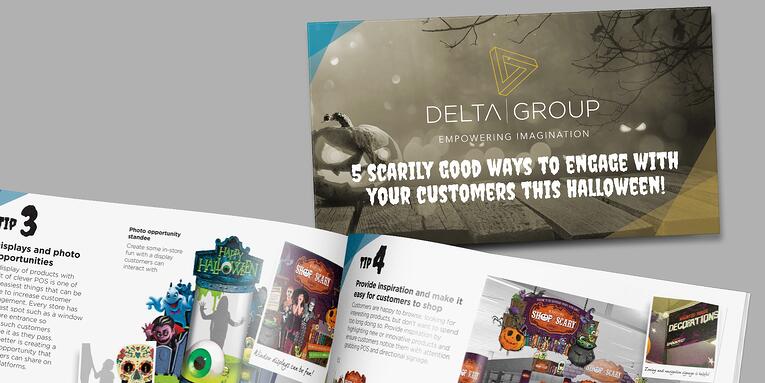
Summer holidays may have started, but in terms of planning, Halloween is not too far away. 

Delta have published our five top tips that should help increase customer engagement and more importantly sales as the busiest time of the year gets underway.

Contact us at hello@thedeltagroup.com to reserve your copy.

Businesses and offices are starting to gear up for their teams returning again to work.

Office managers are looking to put in place prudent and innovative safety measures.

Your plans for bringing people back into the workplace may need safety screens, new traffic flow guidance and digital signage.

Delta is offering ‘Advisory Signage’ and Personal Protective Equipment with suggestions and ideas for workplace traffic management, social distancing and responsible purchasing.

Protect staff, customers and visitors in your:

  • Retail estate
  • Warehouse
  • Office
  • Canteen

Branding – all the signage can be branded bespoke to your brand by Delta Creative, our in-house design agency.

Delta is here to help. Please email hello@thedeltagroup.com for more information.

Click the image below to open the PDF.

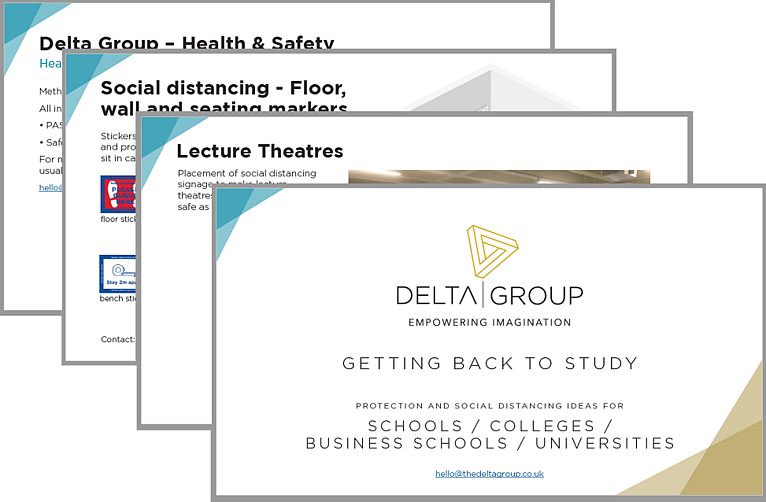
Students may be working from home right now but soon they’ll be back to study.

To be prepared, colleges, schools, business schools and universities should check our range of Advisory Signage and COVID-19 personal protective equipment to help manage social distancing on campus and ensure a safe and compliant working environment for staff and students alike.

Whether that be focused on protecting staff / teachers, pupils or students in your:

  • School
  • College
  • Business School
  • University

Branding – all the signage can be branded bespoke to your brand by Delta Creative, our in-house design agency.

Delta is here to help. Please email hello@thedeltagroup.com for more information.

Click on the image below to open the PDF.


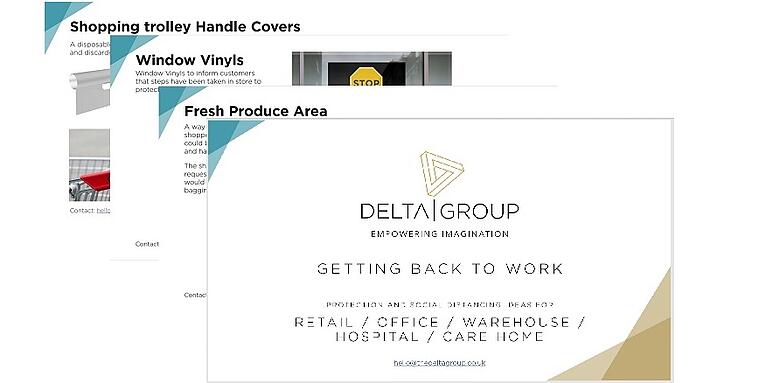
We’re looking forward to getting Back To Work, but we don’t expect it to be Business As Usual.

That’s why we’ve expanded our ‘Advisory signage and Personal Protective‘ equipment with suggestions and ideas for customer traffic management, social distancing and responsible purchasing.

Whether that be protecting staff, customers or patients in your

  • Retail estate / Office / Warehouse / Hospital / Care home

Click on the image below to download instantly:


Branding – We can provide a creative artworking solution to design all of the ideas aligned to your brand guidelines.

Retail clients and brands are starting to think about how they will serve their customers when the lockdown is lifted. They are starting to plan new ways of interacting with and managing clients as they come through the door and move around the store. The most successful organisations are able to offer a welcome, practical steps and reassurance, as well as providing the goods and services that they sell best. 

Best selling items include:

  • Sanitisation stations – made of wood and wipeable card, plus anti-bacterial hand-gel, dispensers and towels
  • Full face visors – transparent plastic headgear
  • Floor stickers and stand-apart signage
  • Queuing barriers – portable, configurable, quick to assemble
  • And many other items – click to view


Our print and manufacturing operations (400,000 square feet of capacity and warehousing) with our installation teams are fully open with versatile staff, technology and distribution to get your production done and installed.

Delta is here to help. Please email hello@thedeltagroup.com for more information.

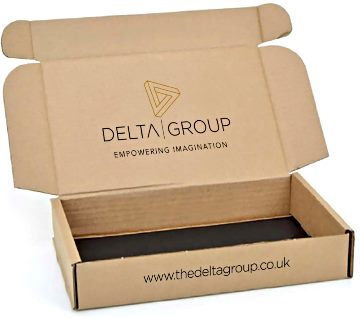
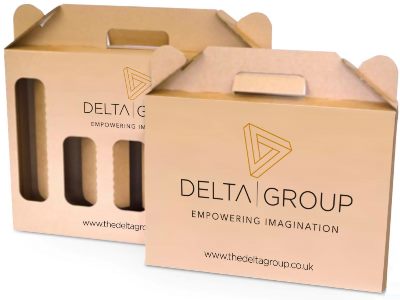
Delta expands its award-winning corrugate display products into e-commerce packaging.

We make packaging bespoke to your needs. Suitable for e-commerce, home delivery, product stability, fully branded.

Our wide format digital press prints direct to corrugate materials with a maximum sheet 1.8m x 3m. We have die-cutting and finishing on-site, providing efficient and cost-effective packaging and display material.

Delta is robust and scalable, with four manufacturing facilities in the UK and Ireland and a logistic network across Europe for deliveries.

To obtain these materials send an enquiry to hello@theDeltaGroup.co.uk